


Hello, I’m Joaquim Menezes, senior online editor at IT World Canada, and in today’s panel discussion we’re going to focus on a truly relevant subject: flexible work strategies.
We have an exceptional panel today.
On my right is Roberta Fox, president and senior partner at Fox Group Consulting, and a board member at the Canadian Telework Association.
And on my left are Ken Rigby, general manager of franchise development for Intelligent Office in Canada, and David Webb, a service manager at Ontario’s Central Agencies I&IT cluster or CAC for short. Welcome to the program folk.
VIDEO: MAKING TELEWORK WORK FOR YOU
Related articles
Becoming a successful and satisfied teleworker — an expert shows how
Telework pilot cruises along and Ontario Central Agencies Cluster
When the economy hands them a lemon smart Canadian firms make lemonade
New workstyles work wonders as Telus
Joaquim: I thought we could start with some definitions to make sure we’re all on the same page. Roberta, you’ve developed a white paper titled Telework and the Virtual Organization. Could you give us a working definition of telework and what are the features of a virtual organization?
Roberta: Thank you very much. Telework is really where you’re using telecommunications and network technology to allow your employees to work from wherever they need to, with customers in the organization … so it could be home offices, branch offices, satellite offices – like what Ken has.
The virtual organization is an add on to that [exemplified by] organizations like Fox Group, which are totally based at different locations, that don’t necessarily come to a central place and the overlay, the people, and processes of how to work together, which is sometime quite challenging.
Joaquim: From all accounts there seems to be surge in telework and virtual organizations today. What would you say are some of the enabling trends for telework?
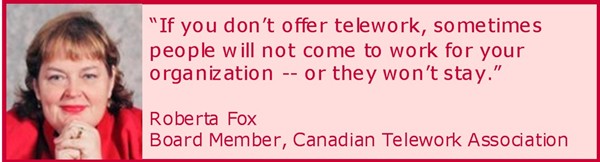
Roberta: The economy has definitely driven a lot of need for telework, as companies are cutting back on facilities. Also the N-Gens, and even us baby boomers are getting more demanding of how we’re going to work together. And if you don’t offer telework programs, sometimes people will not come to work for your organization or they won’t stay. So it’s economic; it’s environmental; it’s attempts to try and have work-life balance.
Joaquim: David you were actively involved in CAC’s telework pilot launched last year. Were the drivers Roberta mentioned – the tech factors, perhaps decreasing telecommunications costs, environmental reasons, the need to retain high-quality staff – were these the main drivers of CAC’s telework pilot, or were there other factors as well?
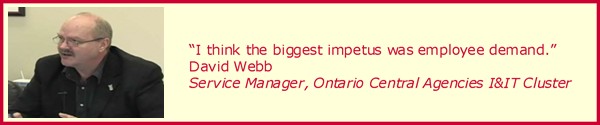
David: I think the real impetus was employee demand – attraction and retention of your staff into the organization to replace some of the grey hairs that are leaving over the next few years was certainly an impetus.
So the key drivers: greening, cutting down on CO2 emissions through reduced travel, reduced printing. The folk working from home don’t have printers at home.
Even those like me, who are paper hogs, have been learning not to use that. Also, we believe the savings on accommodation are really going to grow over time. But in the pilot we chose not to take dedicated workspace away from the teleworkers.
Joaquim: So in retrospect – now you’ll are now around 10 months into the pilot – what kind of feedback are you’ll getting from employees and managers in terms of these goals you’ve mentioned?
David: Very, very encouraging. We’ve done surveys of the teleworkers, of managers of the teleworkers and our employees at large, and the feedback is extremely positive.
The number one concern when we started off was managers thinking they would not be able to manage remote workers. But through training and various other kinds of communication strategies we got around that. Both employees and managers are saying we are as productive, or more productive, than we were before telework. Employees are as available or more available, the quality and the quantity of the work [hasn’t suffered].
Employees are saying some of the obvious things … “I’m less stressed because I’m not travelling. I have more time to do heads down work because I have fewer interruptions — nobody is dropping into my office. They are reporting better relationships between teams.
On the somewhat negative side, managers are still concerned about performance management. They haven’t noticed any performance degradation, but believe that productivity has actually improved.
The pattern that we chose was three days in the office and two days in your home office.
Joaquim: Ken — Roberta talked about this whole concept of a virtual organization, but within the context of telework. Now, in terms of Intelligent Office, it seems to me that you’ll take this concept to another level. So it’s not just the employee who works at an alternate location for a specified number of days a week, but the office itself that’s virtualized. Could you explain this concept a bit more, and the value proposition especially for smaller and mid-sized businesses?
Ken: Yes, so basically we combine whatever they’ve talked of here about allowing workers to work remotely – whether it’s from home, their cottage, or a vacation spot. As long as workers have the ability to be connected, they can connect to our backbone, which allows us to give them remote access, and connect to mobile messaging, mobile telephone services. So they have the freedom to work wherever they want, whenever they want — with all the benefits of a traditional office behind them, backing them.
Joaquim: I remember Brian Monteith, master franchisor of Intelligent Office in Canada, at an SME event last year, mentioning that where others saw the recession as a challenge, for Intelligent Office it was actually an opportunity, and it grew business.
Ken: That’s true. It’s been fantastic for us. We’ve actually flourished through the whole recession, because you find companies and government organizations that try and save costs. So we can come in and provide all those services and that backbone for those organizations, it gives them the ability to allow their staff to work from home, or from another location but still have all the benefits of the office.
We would provide locations for meetings so they wouldn’t necessarily have to come all the way down to Toronto if it’s more convenient for them to meet in North York or in Mississauga, or where any of those locations are.
They could still come in, utilize one of our board rooms, if they need to connect via video conferencing or teleconferencing, all that equipment is there for them. But it still gives them the ability to work remotely.
Again, you reduce your carbon footprint, because instead of coming all the way down to Toronto, if everyone is located in Mississauga, they can just touch down in that location, and still be connected to everyone.
Joaquim: That’s a great segue into our next question. Dave apart from employee demand for telework, it’s an acknowledged fact that the success of a telework program depends a lot upon the tools and technologies that are provided. So I’d like you to talk about that. What kinds of tools were provided to participants in your telework pilot?
David: We made a conscious decision when we started to crack the cultural and HR nut. We thought the biggest hurdle for us would be cultural and performance management. So we thought on the hardware and software side, and the tool set, let’s keep it simple.
We didn’t want to introduce any new technologies to folk, and that’s been a good decision. We chose a standard notebook that’s been supported in our organization for years, and we have a great support organization to take care of that. [Then we offered] a remote access connection, a teleconference bridge, and a phone in the home office. That’s it. We used Outlook and whatever other collaboration tools we had at the time.
What we did do, though, is provide training and best practices in tracking your work, for example. Also, [we offered] managers training in moving from line-of-site management to management by performance outcome.

Joaquim: Talking about best practices, Roberta your company offers consulting services covering many different kinds of flexible work programs. So are there certain basic tech tools you a teleworker would absolutely require?
Roberta: Absolutely. I agree with what Dave mentioned about his tools. I think the most important underlying piece to have, if you don’t already have it, is high-speed. Because everything we do is based on having high-speed, wired or wireless.
Also the technology is important, but so are the physical facilities … a good desk, good chair, base unit things you have to think about.
And the ability to use the tools, so being pretty self-sufficient, so you know how to use the programs you were using at the office. That’s being a more knowledgeable technology user.
And the last piece is: if you need to do printing it’s important to have either Staples cards or something like that enable you to do production type photocopying and printing when required.
So that’s facilities/technology. If the employee is a full-time teleworker and has no office then you have to scale down what they had at the office to enable them to do their jobs at home.
Joaquim: Roberta, Ken, Dave – thanks so much for participating in today’s program on flexible work strategies.

